Productivity
Why your team's sprint health keeps dropping — and how to fix it
AK
Alex Kim
Co-founder & CEO, Focusly
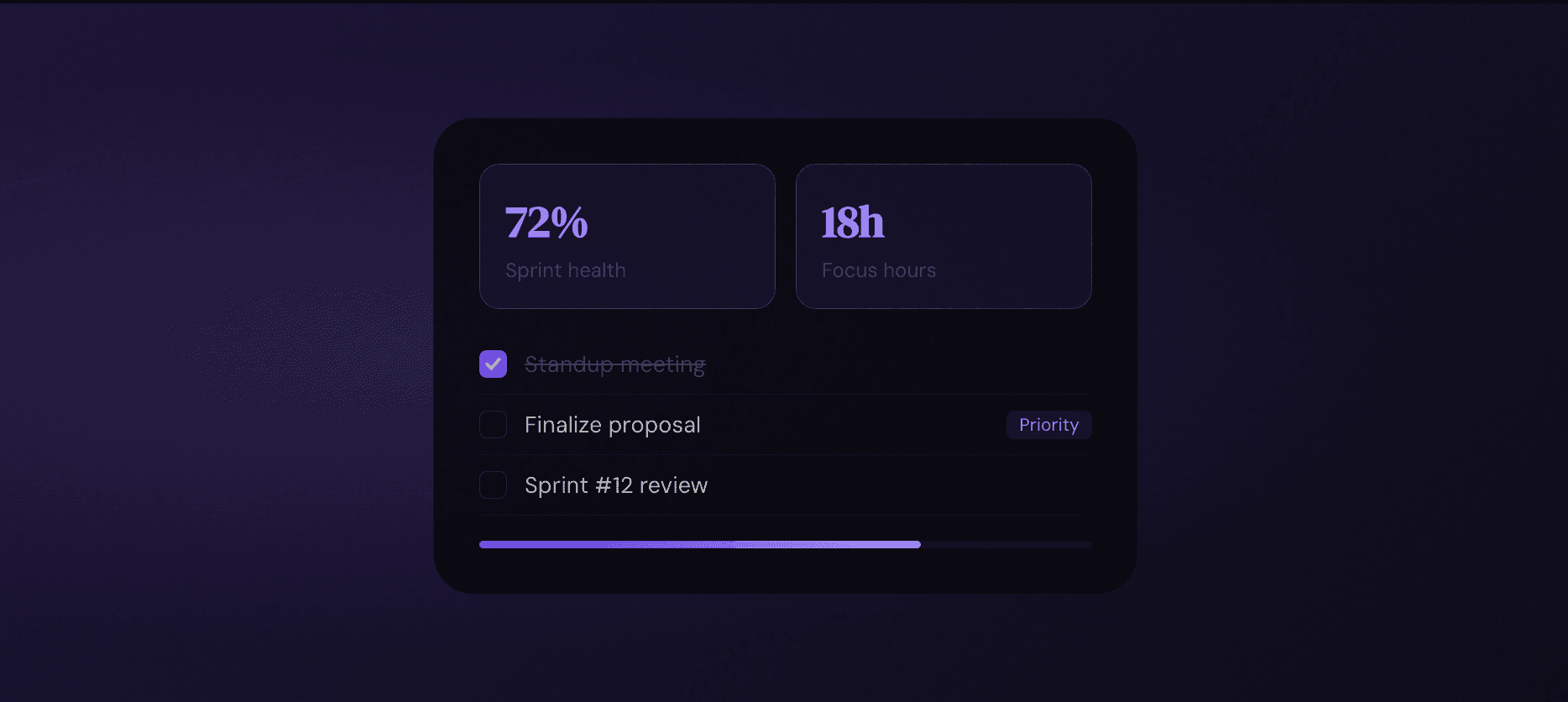
Sprint health is one of those metrics that looks fine right until it doesn't. Teams check it at the end of a sprint, discover it's at 58%, spend 20 minutes in a retrospective trying to explain why, and then watch it happen again next sprint. The problem isn't the metric — it's when you look at it.
Sprint health is a lagging indicator. By the time it's dropped, the damage is already done. The missed tasks, the rushed handoffs, the focus hours that never happened — those are the cause, not the effect. If you want to fix sprint health, you need to start watching the leading indicators instead.
The core insight: Focus hours tracked per team member, task completion rate before Thursday, and number of priority tasks left unstarted by Wednesday — these three numbers predict your sprint health outcome with remarkable accuracy. None of them require a retrospective to measure.
The three leading indicators that actually predict sprint health
After analyzing patterns across 2,400 teams using Focusly, three numbers emerged as the most reliable predictors of sprint outcome. They're simple enough to track without any tooling — but measuring them consistently is where most teams fail.
1. Focus hours per person per week
Teams that consistently hit 15+ focus hours per person per week maintain sprint health above 70%. Teams averaging below 10 hours almost never finish a sprint clean. The relationship isn't linear — it's a threshold effect. Below a certain amount of protected, uninterrupted work time, output degrades faster than the hours lost would suggest.
2. Priority task start rate by Wednesday
If your highest-priority tasks haven't been started by Wednesday, you almost certainly won't finish the sprint at a healthy rate. This is the most actionable indicator — it's a clear, visible signal with four days left in the sprint to course-correct.
The fix is simple in theory: surface unstarted priority tasks prominently on Monday morning. Make it impossible to ignore. In Focusly, priority tasks appear at the top of the dashboard with a distinct highlight — not buried in a flat list where they look identical to everything else.
3. Context switches per day
Track how often each team member switches between tasks in a given day. High context-switching correlates almost perfectly with low sprint health. Not because switching is inherently bad — sometimes it's necessary. But unplanned, reactive switching is a symptom of a workspace that isn't protecting attention.
How to use focus sessions to fix it
The most effective intervention we've seen is deceptively simple: each team member starts every workday with a single focus session on their highest-priority task before opening email, Slack, or any other communication tool. No exceptions.
This isn't a productivity hack — it's a structural protection for the work that matters most. In sprint terms, it means your priority tasks get real, uninterrupted attention every morning instead of getting squeezed into whatever gaps are left after reactive work takes over.
Teams that adopted daily morning focus sessions saw sprint health improve by an average of 18 percentage points within 6 weeks. Not because they worked more hours — but because those hours were better protected.
The role of AI prioritization
One of the hidden costs of poor sprint health is decision fatigue around what to work on. When everything feels urgent, nothing feels prioritized, and teams default to whatever is loudest — which is rarely whatever is most important.
AI prioritization solves this by removing the decision entirely. Instead of each team member starting their day by scanning a task list and making judgment calls, the system surfaces the single most important thing based on deadlines, sprint health, and historical completion patterns. You open the app and you know what to do first.
A simple sprint health protocol
Monday morning: Each team member runs a 25-minute focus session on their top priority task before anything else.
Wednesday check: Review unstarted priority tasks. If any exist, reassign or descope immediately — don't wait for Friday.
Thursday standup: Instead of status updates, share one number each: focus hours this week. If anyone is below 10, the team helps remove blockers for the final two days.
Friday retrospective: Skip the lagging indicator analysis. Review leading indicators instead: were priority tasks started on time? Were focus hours protected? What caused the most context-switching?
Sprint health isn't something you fix in a retrospective. It's something you build proactively, one focus session at a time, by watching the right numbers before the sprint ends rather than after.
Ready to do your
best work?
Join 2,400+ teams already using Focusly to focus, ship, and stay in control.
©2026 Focusly. Powered by Framer
Designed by Riyad Sbeitan